I first want to acknowledge I may use the word ‘poultry’ a lot in this post, which I personally find very whimsical.
It makes me feel like I’m in the early 1840’s or something, bursting from a snow-covered window ledge like:
‘One poultry, good sir!’
But I use the term poultry in this post only because it can apply to two birds, and I just don’t want to be listing the damn birds every single time. So poultry it is.
I second want to acknowledge my queen, Nigella Lawson, who changed everything I know about bringing poultry when I read her Christmas book, Nigella Christmas (2008). I’d never heard of brining poultry before reading this book, and now I have absolutely zero concerns about poultry ever being dry or flavourless when following her guidance, knowing Christmas has, indeed, been saved.
Brining, essentially, is like reverse osmosis, because you’re putting meat in a very (very) salty bath for a very (very) long time, which draws out any excess flavourless water from the meat, welding the meat closer to the bone (which famously adds more flavour), and without all that excess water, it makes the meat softer, juicer, easier to carve, and absolutely blasted with all the flavours you put in the bath.
So before I gesture you to my brine recipe, I must, out of pure respect, guide you to Nigella’s first.
Following on from this inspiration, I now brine my poultry every single year.
I brine poultry all-year-round to be honest, not just in spiced, salty water, but in all sorts of various liquids and dry spices. Any chicken recipe on my website is likely have been left to marinade in something overnight, and I even itemised a dry-brined and butterflied turkey in my Christmas ebook, Get Stuffed.
But when cooking for a crowd, I often turn to the recipe below for peace of mind.
It takes so much stress out of cooking chickens, which sometimes can be lacking in flavour, or big turkeys, which are often tricky to stop from drying out. The combination of citruses, warming, spices, and aromatic herbs guarantee a flavour depth that will sit alongside all other flavours on the plate with combating them, while the overnight brining promises that there will never be a dry slice offered.
There’s also something so comforting about the fact that this can be prepped in advance and left to brine, which means it’s one thing of your mind (and your kitchen counter) so you can focus on other things that will demand your time at Christmas.
I would definitely use this brine throughout the year, don’t get me wrong, but there’s also something cozy and special about keeping it for this time of year that feels celebratory. Like ‘oh, there he goes with the big, metal tub. It must be Christmas.’ And yes… yes it is Christmas, and there are certain things you wait for to summon in that time of year. Some people wait for the Coca Cola advert, I wait until we bust out the big tub.
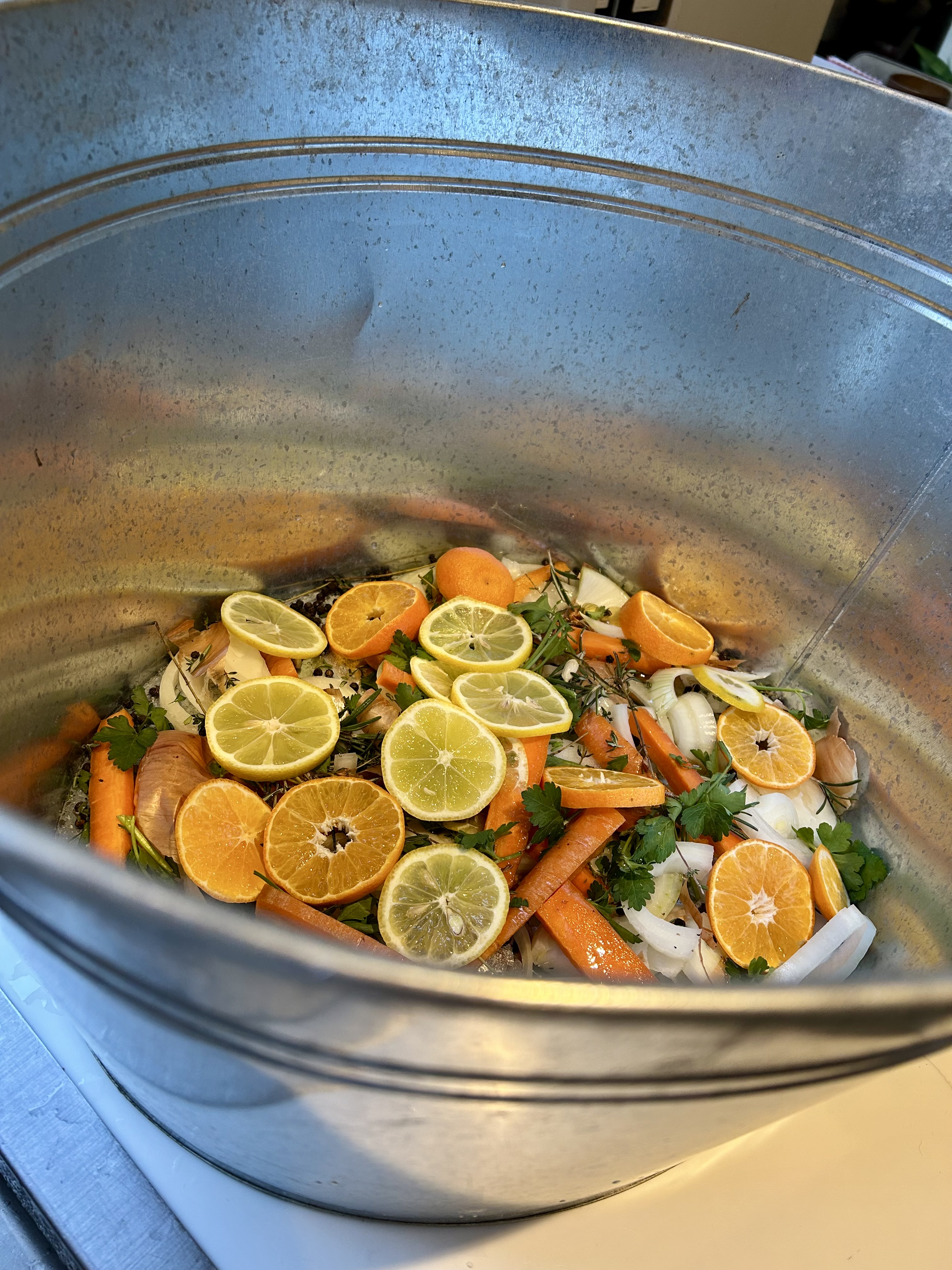
So let’s talk measurements.
First off, let’s banish the embarrassment of having a chicken at Christmas, please. Not everyone comes from a massive family and needs an entire turkey. A chicken can do exactly what a turkey needs to do for a smaller family, so let’s not feel ashamed if we’re using just chicken. In fact, I cooked two chickens last year instead of a turkey for no reason other than I just preferred to do it that way.
So let’s say you’re cooking a chicken for Christmas. In which case, I recommend cooking two and cooking two is no harder than cooking one. I say two because leftover poultry meat is the end goal for me of any Christmas and one chicken just won’t yield the yummy promises of leftovers, so two satisfies that urge.
So, if you’ve got two chickens (say 1.5kg each? Roughly?) you’re looking at 3 -4 litres of water to fully submerge them. For something larger, like a turkey, (call it 6-7kg?) you’re aiming more for 8 – 10 litres to cover the birds.
And salt?
Well, the salt ratio will remain at about 200g salt per 3 – 4 litres of water, with the sugar and aromatics scaled proportionally to this.
Below, I’ve gone on the basis of two chickens, only because this is what I was working with the last time I made this brine and it served the most perfect chicken I have possibly ever tasted.
For best results, I say for chicken brine overnight (8 – 12 hours would be brilliant) but for turkey you will need a little longer (say 12 – 18 hours) because the meat is thicker and needs longer to penetrate. The key thing is that you need the brine cold, cold, cold. I like to keep mine outside, covered tightly, either with something heavy resting on top, or kept in the garage. If you don’t have the ability to do this, keep it indoors, but add a lot of ice to keep it as cold as possible.
Now, some thoughts, because the elements of the brine are yours to determine to your personal taste. The water and salt are non-negotiable, of course, because that’s brine, but what you put in it? Lord, that is your canvas to paint.
The recipe I’ve outlined below is my ideal set-up, but that’s not saying there are a thousand and one variations on this. For example:
- Sugar – I’ve used honey and brown sugar, but you could substitute for white sugar and maple syrup and it would be just as good. Or a combination of all of them, but keeping to the same loose ratios as below.
- Citrus – go wild. Limes, lemons, oranges, clementines, mandarins, tangerines, grapefruits, do what you need to do to pack that brine with sharp, citrus blasts.
- Herbs – again, do what you need to do. Parsley, thyme, sage, oregano, tarragon. I don’t really go for mint or dill here, nor coriander actually, but you could. I also, controversially, don’t include rosemary in mine, I think it’s a bit of a bully in a brine, but that’s not saying you couldn’t or shouldn’t if you’re a rosemary fan. It’s your brine and you must decorate it as such.
- Aromatics – go as wild as you desire. Ginger would be beautiful, as would some fennel seeds, coriander seeds, allspice berries, mustard seeds, cardamom pods, juniper berries. There truly are so many routes you can take, and I want you to explore them all.
- Bay leaves – not for me.
In short, brining is the kind of liberation you seek when cooking and planning for poultry, specifically at Christmas, and let the flexibility of this template reassure you that, essentially, so long as you’re soaking poultry in water with a lot of salt and other tasty bits, you will guarantee yourself a treat at the dinner table the next day.
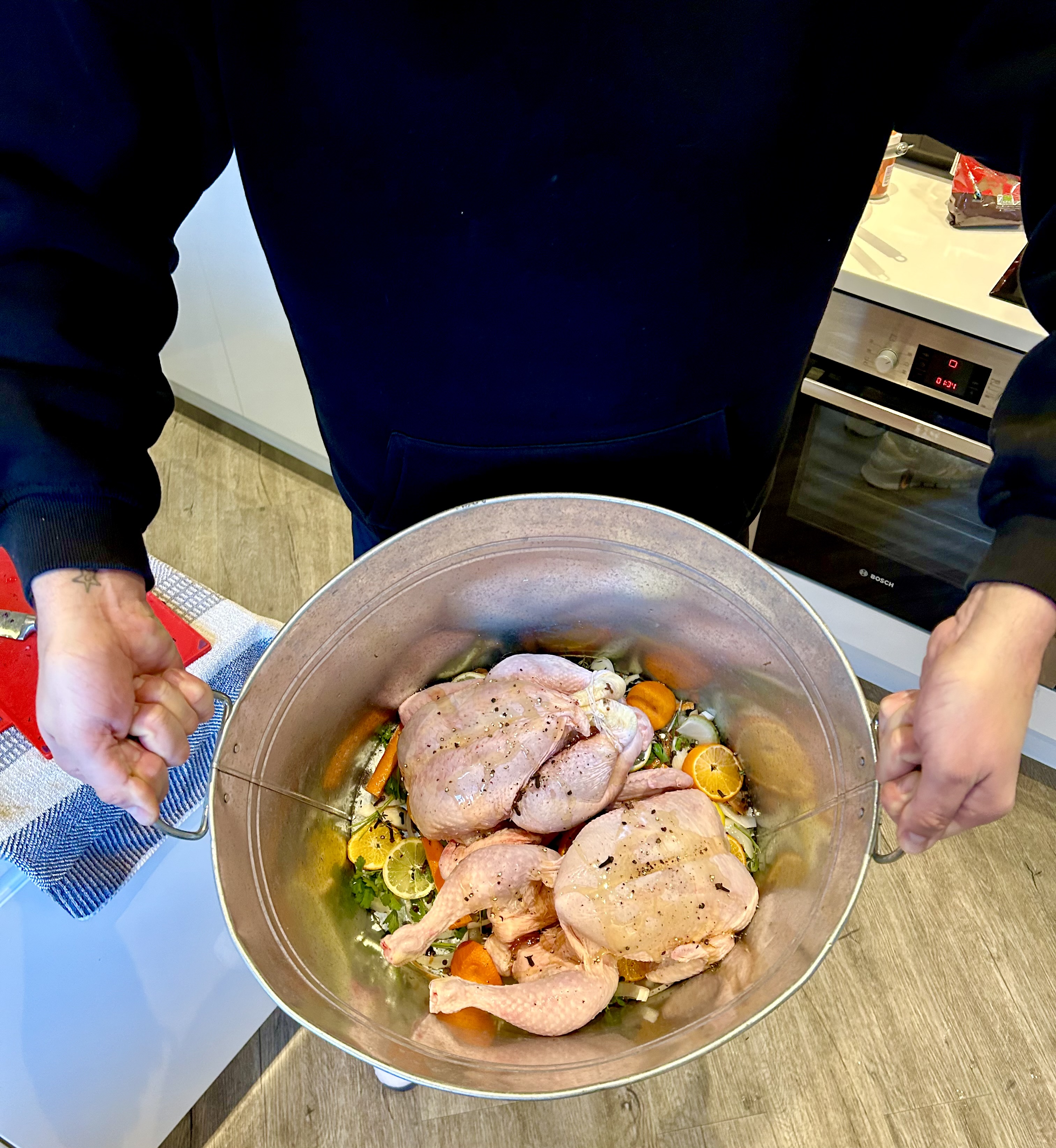
Makes 4 litres of brine for x2 chickens
x2 1.5kg chickens
200g sea salt
100g brown sugar
85g honey
4 garlic cloves – smashed with the blunt side of a knife (unpeeled)
2 onions – quartered (unpeeled)
2 carrots – chopped (unpeeled)
1 tbs black peppercorns
4 cloves
4 star anise
2 cinnamon sticks
A handful of torn parsley
A handful of thyme sprigs
4 litres cold water
2 clementines or oranges – quartered (unpeeled)
1 lemon – quartered (unpeeled)
- In a large tub that you can cover, combine everything in the ingredients list up until the citrus. You could salt and pepper your chicken before you pour in the water but the water will wash it off, so it’s kind of pointless, but still.
- Squeeze in the juice of the clementines (or oranges) and lemon, toss in the squeezed husks, and then give the tub a stir.
- Keep covered in a cold place overnight (see intro) remembering to remove the chickens from the brine with enough time to bring to room temperature before cooking, roughly 1 – 2 hours.
 MIKEY AND THE KITCHEN.